

Key Concepts
Fabrica connects real property to blockchain infrastructure through a carefully designed system. Understanding these core concepts helps you see how onchain ownership actually works.
Property Tokens
Each property is represented as a Property Token, an ERC-1155 NFT that serves as the authoritative record of beneficial ownership.
What the token represents:
- Full ownership rights to the underlying property
- The ability to transfer, sell, or use as collateral
- Access to property metadata, documents, and validation status
What makes it work:
- Standard NFT interface means compatibility with wallets, marketplaces, and DeFi protocols
- Onchain metadata provides transparency about property details and status
- Transfer the token, transfer ownership, no separate paperwork required. A theft does not itself transfer ownership: the true owner keeps their rights against the thief and anyone who knew, while a good-faith buyer who pays value without notice is protected, with the victim's claim shifting to the wrongdoer
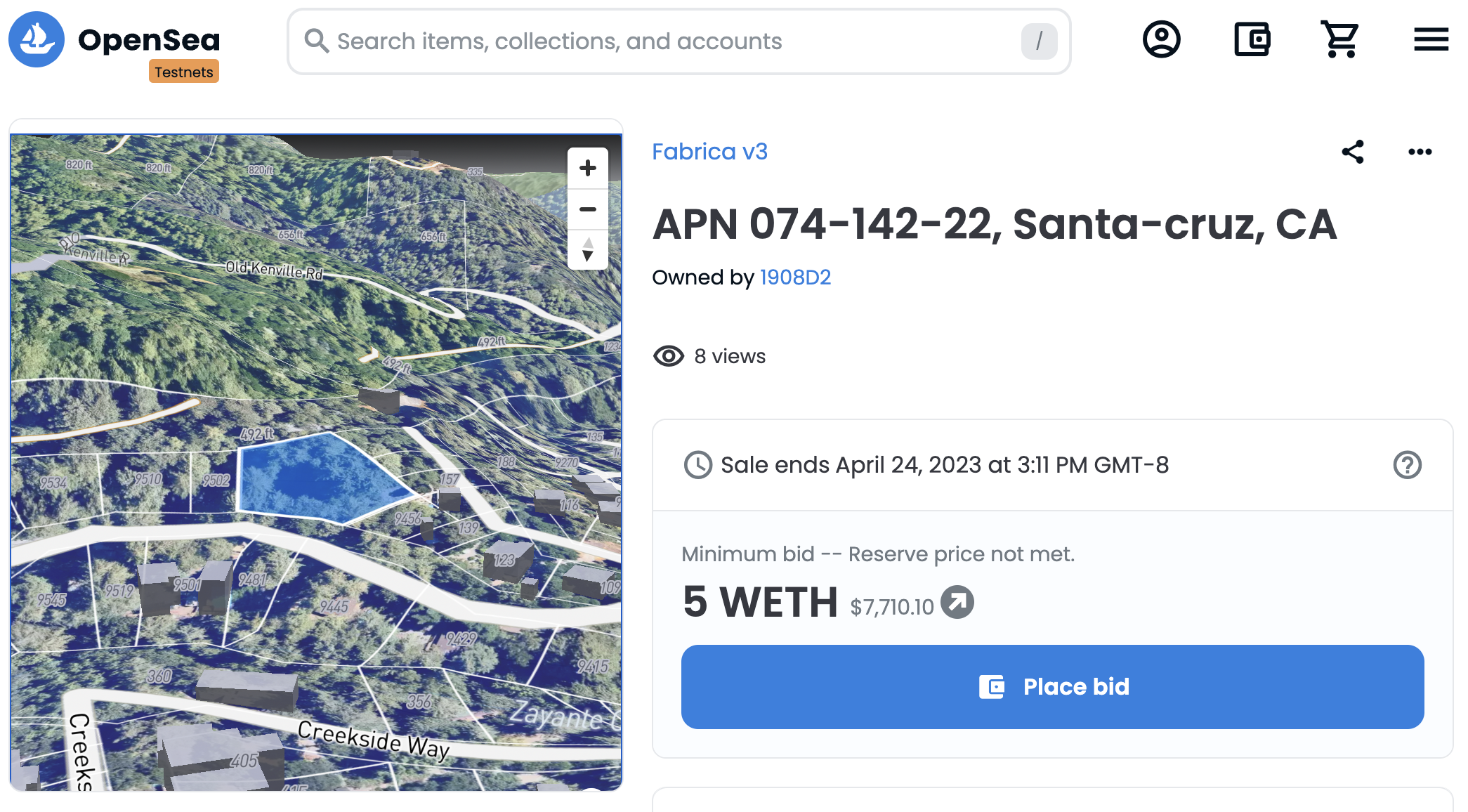
A property in California for sale on OpenSea
Legal Wrappers
Property tokens need a bridge to the traditional legal system. Legal Wrappers provide this connection, retrofitting the existing legal system rather than replacing it.
In the United States, Fabrica uses a purpose-built trust structure:
- The Fabrica Trust holds legal title to the property at the county level
- The property token represents beneficial ownership of that trust interest
- Token transfers automatically transfer the beneficial interest, no deed required
This structure was developed through 8 versions of the trust agreement, refined since 2017 and now open-source. It is designed so that:
- Property rights are protected under existing law, built on UCC Article 12 (property tokens are designated controllable electronic records)
- Transfers are designed to be recognized by courts and have been accepted by title companies
- Owners maintain full control without company intermediation
The legal wrapper is the innovation that makes onchain real estate possible. It's not a workaround, it's a carefully constructed interface between two systems. The wrapper is also asset-class-agnostic: the same trust structure can hold any deeded real property. Fabrica focuses on land first because raw land is the most underserved and least encumbered case, but the mechanism is the same for any property type.
Validators
Validators are the trusted parties that verify and maintain property tokens. Tokens are minted by the smart contract, not by the validator; minting is permissionless, and Fabrica typically mints on the owner's behalf through its interface as a convenience. Either way the token represents the owner's property, Fabrica does not own or control it. Validators perform the critical functions that keep the system reliable:
When a property is added:
- Verify the property owner's identity and authority
- Confirm clear title through title search
- Prepare and record legal documents
- Confirm the property is ready for the owner to mint the token
Ongoing:
- Monitor property status (taxes, liens, encumbrances)
- Run and maintain Property checks on each token
- Forward mail and official correspondence
- Update metadata when property details change
Validators are licensed, bonded, and accountable. In the US, Fabrica's validator holds 20+ regulatory licenses. It has operations across all 50 states with varying degrees of functionality, and 3,000+ counties covered, the result of years normalizing jurisdiction-specific rules into a single coherent system.
How They Work Together
The three components form a complete system:
- Token provides programmable ownership and DeFi integration
- Legal wrapper is designed to make each transfer legally effective
- Validator maintains the link and keeps the system trustworthy
When you transfer a property token, you're not just moving a digital asset, you're executing a transfer designed to be legally binding: beneficial ownership of the trust that holds title moves with the token. The token does not point to the property, it controls it: control of the token carries beneficial ownership, and transferring the token to another owner conveys that ownership, while record title stays within the trust. Transfers into functional contracts such as lending or escrow are the exception, holding the token in custody without changing beneficial ownership (see Fabrica Trust).
Core Principles
These concepts reflect Fabrica's design philosophy:
Non-Custodial Ownership
You hold your property token yourself. No custodian, no company, not even Fabrica, holds it for you or can take it. And your ownership does not depend on us: if Fabrica disappeared tomorrow, your rights under the trust would still stand, all the way to a deed in your name.
Legal Compatibility
We work within existing property law, not around it. Fabrica tokens are designed to be recognized by courts, accepted by title companies, and built to comply with applicable regulations.
Open Infrastructure
Property tokens use standard interfaces. Developers can build applications, marketplaces can list properties, and lending protocols can accept collateral, all without Fabrica's permission or involvement.
Transparency
Property status and validation history are visible onchain, and Property checks are published for each token. Buyers and lenders can review them before transacting.
Next Steps
Ready to see these concepts in action?
- Property Lifecycle, How properties move onchain and off
- Trading, Buy and sell property tokens
- Lending, Use your property as collateral
- Technical Architecture, Deep dive into the protocol design
- For Capital Providers, Lend against tokenized land
- For Real Estate Professionals, List, broker, and close tokenized property
Updated 13 days ago